Master Online Piano Sight-Reading: A Comprehensive Guide
Unlock Your Piano Potential: The Ultimate Guide to Sight-Reading Online.
Have you ever looked at a page of sheet music and felt like you were trying to read a secret code? You're not alone. For many aspiring musicians, the art of sight-reading—playing music from a written score at first sight—can feel like an impossible challenge. It seems like a skill reserved for seasoned professionals, not for someone just starting their musical journey.
But what if you could learn this skill without expensive books or intimidating lessons? What if you had a tool that could show you the music and let you play it, all in one place, for free? Today, learning to read music is more accessible than ever before, thanks to innovative online platforms. This guide will break down the fundamentals of sight-reading into simple, manageable steps.
We will walk you through the basics of reading sheet music, offer practical exercises, and show you how to use a powerful tool to accelerate your progress. Get ready to transform those mysterious symbols into beautiful melodies. Ready to begin your journey as a confident piano player? Start playing now.
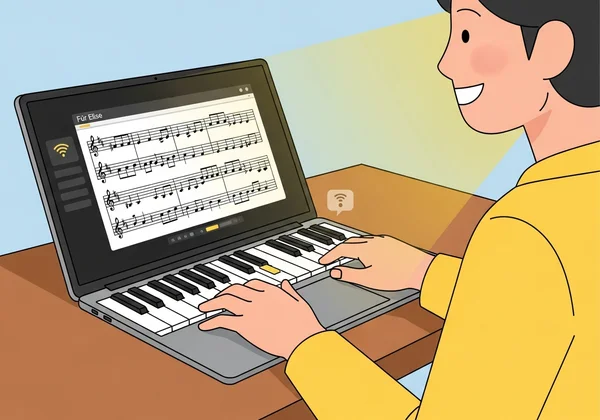
Learn to Read Sheet Music Online: The Foundations
Before you can run, you must learn to walk. In music, this means getting comfortable with the language of sheet music. It might look complex, but it's built on a few simple, logical rules. Let's break down the essential building blocks you need to start your sight-reading adventure.
Deciphering the Grand Staff: Notes, Clefs, and Key Signatures
Think of sheet music as a map. The main part of this map is the grand staff, which consists of two sets of five lines and four spaces, connected by a brace. The top set is usually for your right hand (higher notes), and the bottom set is for your left hand (lower notes).
- Clefs: At the beginning of each staff, you'll see a symbol called a clef. The treble clef (the curly one, or G-clef) marks the top staff, while the bass clef (the one that looks like a C with two dots, or F-clef) marks the bottom one. These clefs tell you which notes correspond to which lines and spaces.
- Notes: The musical notes are the dots placed on the lines or in the spaces. Their vertical position tells you the pitch—how high or low the sound is.
- Key Signatures: Sometimes, you'll see sharp (♯) or flat (♭) symbols next to the clef. This is the key signature, and it tells you which notes to play as sharp or flat throughout the piece.
Understanding Rhythm and Timing: Note Values and Rests
Music isn't just about playing the right notes; it's about playing them at the right time. This is where rhythm comes in. The shape of a note tells you how long to hold it.
- Whole Note (o): Usually held for four beats.
- Half Note (d): Held for two beats.
- Quarter Note (♩): Held for one beat.
- Eighth Note (♪): Held for half a beat.
You'll also see symbols called rests, which represent moments of silence. Just like notes, rests have different shapes that tell you how long the silence should last. Mastering rhythm is crucial for making your music sound fluid and expressive.
Your First Steps with Our Online Piano's Score Display
Reading about music theory is one thing, but applying it is where the real learning happens. This is where a tool like our online piano platform becomes your best practice partner. Our platform has a unique Score Display feature that shows you sheet music right next to a virtual piano keyboard.
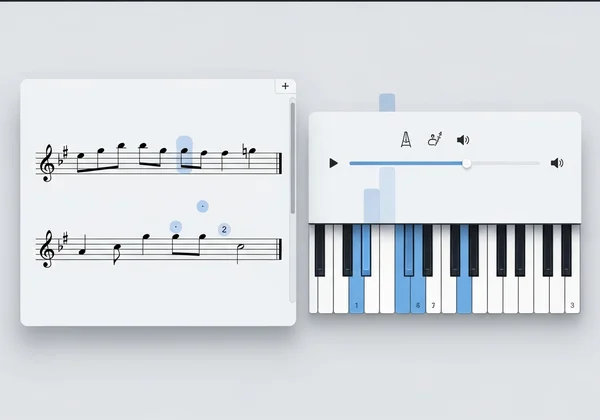
This integrated view removes the hassle of switching between a book and your instrument. You can see a note on the staff and immediately find its corresponding key on the piano. It’s the perfect environment for beginners to connect the written notes with the sounds they produce. Why not try it now? Pull up our virtual piano, open the score display, and start matching the notes you see to the keys.
Improve Piano Sight-Reading Skills with Progressive Exercises
Once you understand the basics, the key to improving your sight-reading is consistent, focused practice. The goal is to train your brain to recognize notes and patterns faster, so your fingers can follow effortlessly. Here are some structured exercises and techniques to build your skills.
Daily Drills: Simple Melodies and Chord Progressions
Consistency is more important than intensity. Spending just 10-15 minutes each day on sight-reading drills will build your skills much faster than one long, infrequent session. Start with very simple pieces.
- Simple Melodies: Begin with familiar tunes like "Twinkle, Twinkle, Little Star" or "Mary Had a Little Lamb." The predictable patterns help you focus on the connection between the notes on the page and the keys under your fingers.
- Basic Chord Progressions: Practice reading and playing simple chords, like C Major followed by G Major. This helps you start thinking in terms of note groups rather than just single notes, which is a vital skill for reading more complex music.
Speed and Accuracy: Techniques for Faster Recognition
As you get more comfortable, you can start working on your speed and accuracy. The goal isn't to play like a virtuoso overnight but to gradually reduce the time it takes to process the music.
- Look Ahead: Try to read one or two beats ahead of where you are playing. This gives your brain time to prepare for what's coming next, preventing awkward pauses.
- Identify Patterns: Instead of reading note by note, look for patterns. Is the melody moving up or down? Are the notes moving in steps or skips? Recognizing these patterns is a mental shortcut that dramatically speeds up your reading.
- Keep Going: When you make a mistake, resist the urge to stop and correct it. Try to maintain the rhythm and keep playing. Finishing the piece is more important than playing every single note perfectly during practice.
Leveraging Our Platform's Lesson Mode for Guided Practice
Sometimes, a little guidance can make all the difference. That's why our platform includes a built-in Lesson Mode featuring popular songs. This interactive feature guides you through a piece, highlighting the notes on the score and the virtual keyboard as they should be played.
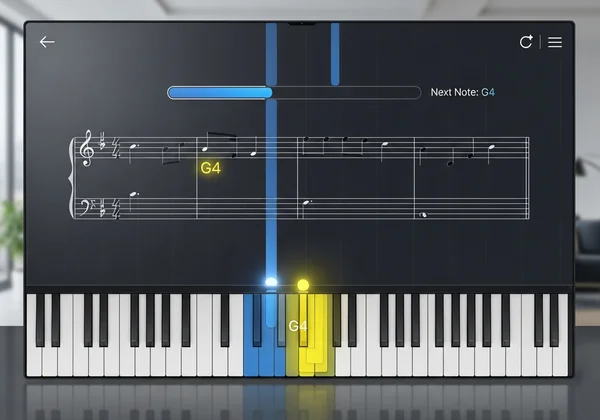
You can slow down the tempo to a comfortable pace, allowing you to follow along without feeling rushed. As you improve, you can gradually increase the speed. This guided practice is like having a patient tutor by your side. It helps you build confidence and accuracy with every session, allowing you to progress at your own pace without pressure. You can practice with lessons anytime you want.
Virtual Piano Practice Techniques for Effortless Sight-Reading
Using a virtual piano for practice offers unique advantages, especially when it comes to developing sight-reading skills. Here are some powerful techniques you can use on a platform like ours to make your practice sessions more effective and enjoyable.
Metronome Mastery: Developing Internal Rhythm and Pace
One of the biggest challenges in sight-reading is maintaining a steady tempo. It's easy to slow down for difficult parts and speed up on easier ones. A metronome is an essential tool for developing a strong internal sense of rhythm.
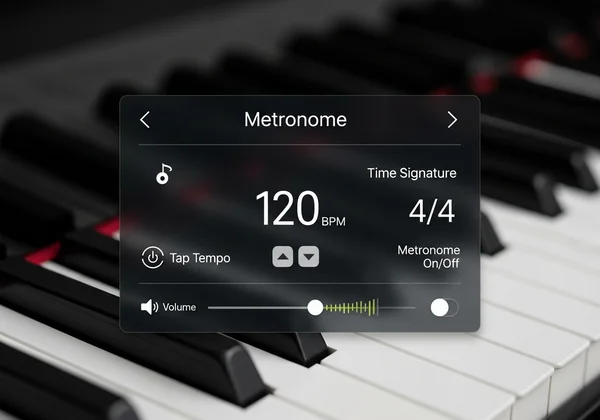
Our platform features a built-in metronome you can activate with a single click. Start by setting it to a very slow tempo. Play a simple piece, focusing on hitting each note precisely on the beat. This methodical practice forces you to read the music in real-time and builds the discipline to keep going, even when you encounter a tricky passage.
Recording Your Progress: Identifying Strengths and Weaknesses
How do you know if you're really improving? By listening back to your playing. Our platform offers two powerful recording features that provide invaluable feedback.
- Audio Recorder: Use this to capture your performance as an MP3 file. Listen back to your playing to check for rhythm, flow, and musical expression. Does it sound smooth, or is it choppy? This helps you identify areas where you hesitate.
- Record Notes: This feature captures the sequence of notes you play, like MIDI data. You can use it to check your accuracy. Did you play the exact notes written on the score? This tool is perfect for spotting recurring mistakes you might not notice while playing.
Finger Placement and Keyboard Familiarity: Beyond Just Reading Notes
Sight-reading isn't just an exercise for your eyes and brain; it's a physical skill for your hands. The more familiar you are with the keyboard, the less you'll need to look down at your hands. This allows you to keep your eyes on the sheet music.
Use the note name display feature on our online piano to help you learn the layout of the keyboard. This feature labels the keys, which is a great aid for beginners. Practice playing scales and simple patterns without looking at your hands. The goal is to develop muscle memory so your fingers automatically know where to go.
Your Journey to Fluent Sight-Reading Starts Now!
Learning to sight-read is a journey that unlocks a new world of musical possibilities. It transforms you from someone who can only play memorized pieces into a musician who can explore any sheet music placed in front of them. As we've seen, this skill is not an exclusive talent but a result of understanding the fundamentals and committing to consistent practice.
Remember these key takeaways:
- Start with the basics: Understand the grand staff, notes, and rhythms.
- Practice smart: Use daily drills, pattern recognition, and tools like a metronome.
- Use the right tools: An integrated platform that combines a score display with a virtual piano is your most powerful ally.
You have everything you need to begin. There are no expensive instruments to buy or software to install. A complete, interactive learning environment is waiting for you.
Ready to turn those dots and lines into beautiful music? Visit OnlinePiano.io today, open the score display, and play your first song from sheet music. Begin your musical journey today!
Frequently Asked Questions About Online Piano Sight-Reading
How can I read piano sheet music online effectively?
To read piano sheet music effectively online, start by understanding the fundamentals of notes, clefs, and rhythm. Use an integrated platform where the sheet music is displayed alongside a virtual keyboard. Practice daily, beginning with simple melodies and gradually moving to more complex pieces. Consistency is the most important factor for success.
Where can I practice piano with a score and get instant feedback?
Our online piano is one of the best places to practice piano with a score. Our platform offers a seamless Score Display feature right next to the interactive keyboard. For instant feedback, you can use our built-in recording functions. The Audio Recorder lets you hear your musicality, while the Record Notes feature helps you check your accuracy against the score, allowing for effective self-assessment.
Is it possible to improve my sight-reading skills quickly with an online piano?
Yes, it is definitely possible. An online piano provides 24/7 accessibility, removing barriers to practice. Features like the Lesson Mode on our platform allow you to slow down songs to a manageable pace, which accelerates learning. With consistent daily practice using these tools, you can see significant improvement in your sight-reading skills in a relatively short time.
What features on your platform help with sight-reading practice?
Our virtual piano tool is designed with sight-reading in mind. Our key features include the integrated Score Display, interactive Lesson Mode with adjustable speeds, a built-in Metronome for rhythm practice, and dual Recording systems for self-evaluation. These tools create a comprehensive environment to learn, practice, and master sight-reading. Explore our features and see for yourself.