Read Piano Sheet Music: Online Piano Guide
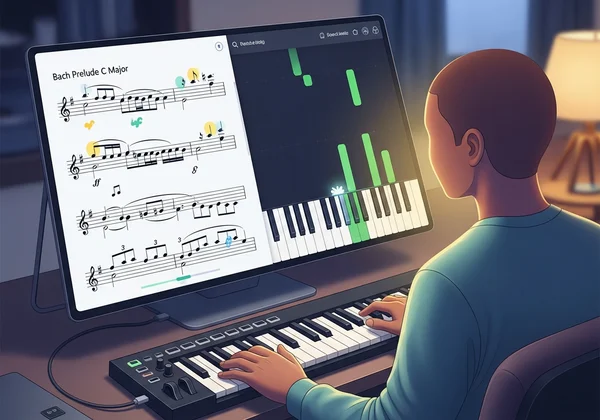
Have you ever looked at a page of piano sheet music and felt completely lost? It's a common feeling. You're excited to play your favorite songs, but those black dots and lines can look like a secret code. What if you could learn to read that code, step by step, with an interactive tool right now? This guide is here to help. We'll turn that confusing musical notation into a language you can understand, using the integrated score feature on OnlinePiano.io to make learning simple and fun.
Let's begin our journey by exploring the fundamentals of sheet music. Think of it as a map that tells you which notes to play, when to play them, and how to play them. By the time you finish reading this guide, you'll look at simple melodies with confidence, knowing exactly how to bring them to life on your piano. Let's start decoding.
Understanding the Basic Components of Sheet Music
Before you can play from a score, you need to know what you're looking at. Sheet music has a few core elements that work together to create music. Once you recognize these parts, the entire page becomes much less intimidating. It's like learning the alphabet before you start reading words.
Staff, Clefs, and the Musical Alphabet
The foundation of all sheet music is the staff (or stave). This is the set of five horizontal lines and four spaces you see across the page. Each line and each space represents a different musical pitch. The notes, which look like dots, are placed on these lines and spaces to tell you which key to press.
At the very beginning of the staff, you'll see a large symbol called a clef. The clef tells you which range of notes the staff represents. For piano, you'll most often see two clefs. The Treble Clef (G-clef) looks like a fancy, swirly '&' symbol. It indicates notes for your right hand, which are higher in pitch. The Bass Clef (F-clef) looks like a backward 'C' with two dots. It indicates notes for your left hand, which are lower in pitch.
The musical alphabet is simple: it's just A, B, C, D, E, F, and G. After G, the cycle repeats. Each line and space on the staff corresponds to one of these letters.
Notes, Rests, and Their Time Values
Notes don't just tell you which pitch to play; they also tell you how long to hold it. The shape of a note indicates its duration, or "time value."
Here are the most common ones you'll see:
- Whole Note (Semibreve): Looks like an open oval. It's typically held for four beats.
- Half Note (Minim): An open oval with a stem. It's held for two beats.
- Quarter Note (Crotchet): A filled-in circle with a stem. It's held for one beat.
- Eighth Note (Quaver): A filled-in circle with a stem and one flag. It's held for half a beat.
Just as important as notes are rests. A rest is a symbol that tells you when not to play. Every note value has a corresponding rest symbol, telling you to be silent for that same duration. Music is as much about the silences as it is about the sounds.

Dynamic Markers: Volume in Sheet Music
Music isn't meant to be played at one flat volume. Dynamic markers are symbols or letters that tell you how loudly or softly to play a passage. They add emotion and expression to the music.
Here are a few basic dynamic markings:
- p (piano): Play softly.
- mp (mezzo-piano): Play moderately softly.
- mf (mezzo-forte): Play moderately loudly.
- f (forte): Play loudly.
You'll also see symbols for gradually getting louder (crescendo, <) or softer (decrescendo, >). These simple instructions are what make a piece of music truly come alive.
Reading Notes on the Piano Keyboard
Now that you understand the symbols on the page, the next step is connecting them to the keys on the piano. This is where the magic happens. A virtual piano is the perfect tool for this, as it gives you a visual layout to practice on without any pressure. You can start mapping the notes you see to the keys right on your screen.
Locating Middle C and the Grand Staff
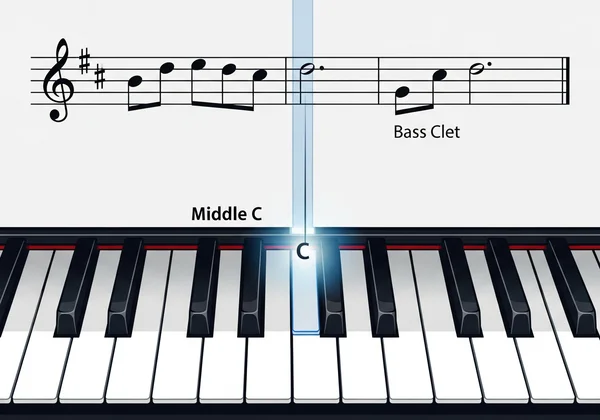
For pianists, the most important landmark is Middle C. It's the C key located closest to the center of the keyboard. On sheet music, Middle C is easy to spot. In the grand staff (the combination of the treble and bass clefs joined together), Middle C sits on a short line (called a ledger line) right between the two staves.
Finding Middle C is your anchor point. From there, you can locate all other notes. Moving up the keyboard to the right corresponds to moving up the staff. Moving down to the left corresponds to moving down the staff. Use Middle C as your home base, and you'll never get lost.
Note Placement to Keyboard Mapping
How do you know which line or space corresponds to which key? Here's a simple trick for the treble clef (right hand):
- Lines: The five lines, from bottom to top, spell out Every Good Boy Does Fine.
- Spaces: The four spaces, from bottom to top, spell the word FACE.
For the bass clef (left hand), you can use these mnemonics:
- Lines: Good Boys Do Fine Always.
- Spaces: All Cows Eat Grass.
At first, you might need to say these phrases in your head. But with practice, you'll start to recognize the notes instantly. The key is to connect the visual on the staff to the physical action of pressing a key on a virtual piano.
Practical Exercise: Find These Notes on Your Online Piano
Ready to try it out? Open the online piano in another tab. Look at the keyboard on your screen. Now, try to find the following notes:
- Middle C: Your home base!
- The G above Middle C: Hint: It’s on the second line from the bottom of the treble clef staff.
- The F below Middle C: Hint: It’s on the fourth line from the bottom of the bass clef staff.
- The notes C, E, and G in your right hand: Find them on the staff, then play them together. You just played a C major chord!
Don't worry about rhythm yet. Just focus on matching the note on the staff to the correct key. This simple exercise builds the fundamental connection between reading music and playing it.
Putting It All Together: Your First Musical Phrase
You've learned the symbols and you know how to find notes on the keyboard. It's time to combine these skills and play a real piece of music. We'll start with a very simple melody to show you how it all works in practice.
Analyzing a Simple Melody Line
Let's look at the first phrase of "Twinkle, Twinkle, Little Star." The first seven notes are: C, C, G, G, A, A, G.
On sheet music, you would see two quarter notes on C, followed by two quarter notes on G, then two on A, and finally a half note on G to finish the phrase. This notation tells you to play each of the first six notes for one beat, and the last note for two beats. The melody is simple, repetitive, and perfect for a beginner.
Step-by-Step Playing Guide Using OnlinePiano.io
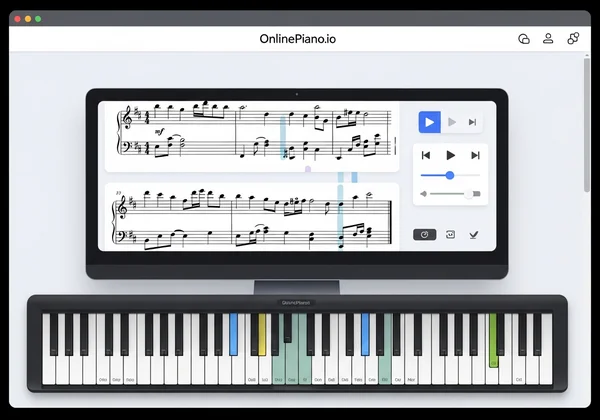
Here’s how you can play this using our integrated learning tools. Our platform lets you see the sheet music and the virtual piano keyboard on the same screen, which is the best way to practice sight-reading.
- Open OnlinePiano.io: Navigate to our free online piano.
- Activate the Score Display: Click the "Score" button to bring up the sheet music interface. You can even find "Twinkle, Twinkle, Little Star" in our lesson mode.
- Identify the First Note: Find the first note on the staff (Middle C). The key will often be highlighted on our virtual keyboard.
- Play the Notes in Rhythm: Press the C key twice, holding each for one beat. Then move your hand to G and play it twice. Next, play A twice. Finally, return to G and hold it for two beats.
- Repeat and Practice: Use the playback feature to hear how it's supposed to sound. You can even slow it down to a speed that feels comfortable.
This "see, hear, play" method is incredibly effective. It creates a direct feedback loop that helps your brain connect the symbols on the page to the sounds you create.
Common Mistakes Beginners Make (and How to Avoid Them)
When starting, it's normal to make a few mistakes. Here are some common ones:
- Mixing up clefs: Accidentally reading a bass clef note as if it were in the treble clef. Solution: Focus on one hand at a time. Practice just the right-hand part, then just the left-hand part, before combining them.
- Ignoring the rhythm: Focusing so much on the right notes that you forget to hold them for the correct duration. Solution: Use a metronome. Our online piano has one built-in to help you keep a steady beat.
- Looking at your hands too much: This breaks the connection between the sheet music and the keyboard. Solution: Trust your muscle memory. Practice finding keys without looking. A virtual piano is great for this, as there's no harm in hitting a wrong note.
Your Journey to Sheet Music Mastery Starts Here
Reading piano sheet music is a skill anyone can master with the right approach and consistent practice. It's a skill that can transform those confusing symbols into beautiful music. By breaking it down into simple, manageable steps, you've learned about the staff, clefs, notes, and rests.
You know how to map those notes to the piano keyboard and how to interpret rhythm and dynamics. Most importantly, you know that practice is the key to fluency. Using an interactive tool that combines sheet music with a virtual keyboard accelerates this process immensely.
Ready to apply these skills and start your musical journey? Open OnlinePiano.io, activate the score display, and start reading your first song today. Experience the joy of playing the piano, right from your browser.
Frequently Asked Questions About Reading Piano Sheet Music Online
How long does it typically take to learn basic sheet music reading?
This varies for everyone, but with consistent practice (15-20 minutes a day), most beginners can grasp the basics of reading simple melodies in the treble and bass clefs within a few weeks. The key is regular, focused practice.
Can OnlinePiano.io help me practice reading different clefs?
Absolutely. Our grand staff display shows both the treble and bass clefs simultaneously, just like real piano music. This is essential for learning to coordinate both hands and is a core part of our platform's design.
What's the easiest way to start reading sheet music as a complete beginner?
The easiest way is to use an integrated tool where you can see the sheet music and the keyboard at the same time. Start with a very simple, familiar song like "Twinkle, Twinkle, Little Star" or "Happy Birthday." You can find guided lessons for these on our online piano to get started immediately.
How does the score display feature help with learning notation?
The score display feature provides instant visual feedback. It connects the abstract symbol on the page to a concrete key on the keyboard, closing the learning loop. Instead of looking back and forth between a book and a piano, everything is in one place, which helps your brain make the connections much faster.