Read Piano Sheet Music: Symbol Guide with OnlinePiano.io
New piano students often face a universal frustration: sheet music symbols look like hieroglyphics. If you have ever wondered what those squiggles, lines, and dots mean when learning to play piano, you are not alone. Staring at musical symbols can feel like decoding ancient code—but it doesn’t have to. Reading music is actually a logical system designed to help you share ideas through sound.
Do you want to turn those mysterious marks into beautiful melodies? This guide will transform sheet music from intimidating code to your personal musical map. We will use hands-on examples that you can try immediately on an online piano. By combining theory with our revolutionary score display feature, you can see the notes and hear them at the same time.
Let’s uncover the essential building blocks of sheet music together—starting with the staff. From the basics of the layout to advanced navigation markers, you will gain the confidence to sit down and play. Your journey from staring at a page to creating music begins here.
Understanding the Building Blocks of Sheet Music
Before you can play a masterpiece, you must understand the "grid" where music lives. Think of sheet music as a graph. The vertical axis tells you which note to play (pitch), and the horizontal axis tells you when to play it (time).
Staff, Clefs, and Notes: Your Musical Foundation
The staff is the set of five horizontal lines and four spaces where all musical symbols sit. Each line and space represents a specific letter: A, B, C, D, E, F, or G. To know which letter is which, we use a Clef.
- Treble Clef: This looks like an ornamental 'G'. It is used for higher-pitched notes, typically played with your right hand.
- Bass Clef: This looks like a stylized 'F'. It is used for lower-pitched notes, usually played with your left hand.
When you use a virtual piano, you will see these clefs clearly displayed. The most important note to find first is Middle C. On a standard keyboard, it sits right in the middle. In sheet music, it sits on a small "ledger line" between the Treble and Bass staves. Understanding this layout is the first step to building a strong musical foundation.
Rhythm and Note Values: Creating Musical Time
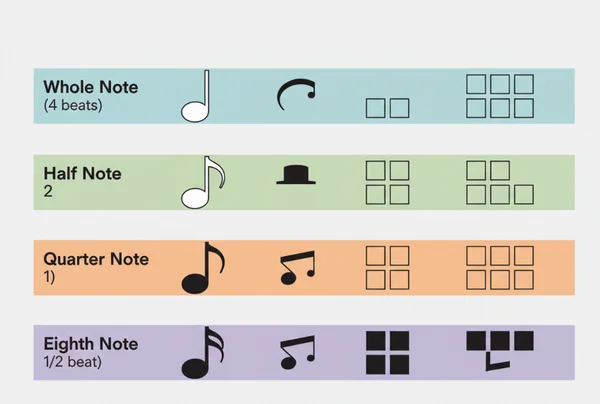
Music is not just about which keys you press; it is about how long you hold them. This is called rhythm. Different shapes of notes tell you the duration:
- Whole Note: An empty circle. Hold this for four beats.
- Half Note: An empty circle with a stem. Hold this for two beats.
- Quarter Note: A solid black circle with a stem. Hold this for one beat.
- Eighth Note: A black circle with a stem and a "flag." Hold this for half a beat.
You will also see "rests," which are symbols that tell you when to be silent. Learning to read piano sheet music symbols involves balancing these sounds and silences. If you find the timing difficult, try the lesson mode on our platform to stay on beat.
Decoding Dynamic and Expression Marks
Once you know the notes and the rhythm, the music can still sound robotic. This is where dynamics and expression marks come in. These symbols tell you the "mood" and volume of the piece.
From Piano to Forte: Understanding Volume Indicators
In the world of music, we use Italian terms to describe volume. You will often see single letters written below the staff:
- p (Piano): Play softly.
- f (Forte): Play loudly and strongly.
- mp (Mezzo-piano): Moderately soft.
- mf (Mezzo-forte): Moderately loud.
There are also symbols for changing volume gradually. A "Crescendo" looks like a wide 'V' opening up, meaning you should get louder. A "Decrescendo" or "Diminuendo" is the opposite, telling you to get softer. Using an online piano notation guide helps you recognize these quickly. This ensures your music sounds expressive rather than flat.
Articulation Marks: Adding Character to Your Playing
Articulation marks are small dots, lines, or curves placed near the note head. They tell you how to physically strike the key.
- Staccato: A small dot above or below the note. Play the note short and detached, like a "ping."
- Legato (Slurs): A curved line connecting different notes. Play these notes smoothly, with no gaps between them.
- Accent: A small sideways 'V'. Hit that specific note harder than the others around it.
Struggling with the bass clef or coordination? Our interactive score display lets you slow down tricky sections—no stress! These small details are what separate a beginner from a performer.
Advanced Symbols Mastery: Navigating Repeats and Codas with Online Tools
As you progress to more complex songs, you will encounter symbols that help you navigate the page. Instead of writing the same melody twice, composers use "shortcuts."
Repeats, Codas, and Other Navigation Markers
Navigation markers act like road signs. They tell you where to go next so you don't get lost in the music.
- Repeat Signs: Two dots placed before a double bar line. Go back to the previous repeat sign and play that section again.
- D.C. al Fine: This stands for "Da Capo al Fine." It means go back to the start and play until the word "Fine."
- Coda: This symbol looks like a target. It marks a special ending section of a song.
Our sheet music tutorials simplify these markers. Try the interactive score display to see how repeats and codas work in real time. The display guides your eyes across these points while you play, ensuring you never miss a beat.
Step-by-Step: Applying Symbols in Practice
Knowing what symbols mean is one thing, but applying them is another. Try this simple workflow the next time you practice:
- Scan the Score: Look for the clef, the time signature, and any repeat signs before you touch a key.
- Identify the Rhythm: Try tapping out the rhythm with your hand to get a feel for the "pulse."
- Find Your Hand Position: Look at the first few notes. Place your fingers on the corresponding keys on the virtual piano keyboard.
- Play Slowly: Don't worry about speed. Focus on accuracy first.
- Add Expression: Once you know the notes, look for the 'p' or 'f' marks to add emotion.
This hands-on approach bridges the gap between seeing and doing. Our platform's score display is designed specifically to help you with this visual-to-physical connection.
Common Sheet Music Challenges and Solutions
Even experienced players run into hurdles. Two of the biggest challenges are shifting the pitch of a song and playing with both hands simultaneously.
Transposition: Playing in Different Keys
Transposition is the act of moving a piece of music to a different key. This might happen if a singer needs the song to be higher or lower. While this sounds complicated, it often just involves shifting every note by the same interval.
If you are using our online piano, you can practice this by finding the same melody starting on a different key. Key signatures (the sharps or flats at the staff’s start) hold the secret to transposition. Learn them, and shifting keys becomes effortless.
Reading Multiple Parts: From Solo to Ensemble
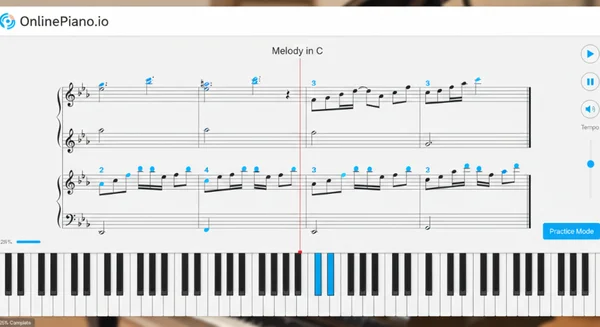
Reading two staves at once is the "final boss" for many beginners. The secret is to look at the music vertically. See which notes align on top of each other. Those are the notes you play at the exact same time.
- Step 1: Practice the right hand alone.
- Step 2: Practice the left hand alone.
- Step 3: Combine them at a very slow tempo.
Our free online piano features a recording tool. You can record your left hand, play it back, and then practice your right hand over the top. This is a fantastic way to build coordination without feeling overwhelmed.
Your Journey to Sheet Music Mastery Begins Today
Remember: every practice session turns those mysterious symbols into musical confidence. By understanding the staff and mastering rhythms, you are no longer just pressing keys. You are interpreting an art form. You have the tools to turn those "hieroglyphics" into a personal roadmap for musical expression.
The most important takeaway is that theory and practice must go together. Watching a video is helpful, but touching the keys while looking at a score is how you truly learn. Our integrated score display and interactive keyboard provide the perfect environment for this growth.
Are you ready to see those symbols come to life? Visit our online piano platform and play piano now. Whether you are practicing your first scale or recording a full song, we are here to make your journey simple and fun.
Frequently Asked Questions About Reading Piano Sheet Music
How long does it typically take to learn to read sheet music?
Learning where the notes sit on the staff can take just a few hours. However, becoming a fluent "sight-reader" takes months of consistent practice. Most students feel comfortable reading simple melodies within 4 to 8 weeks. The key is to start playing every day, even if it is just for ten minutes.
What's the best way to practice reading music while using an online piano?
The best method is to use a "split-screen" approach. On our platform, you can open the Score Display directly next to the virtual keys. This allows your eyes to move naturally from the notation to the keyboard. Try to say the names of the notes out loud as you press the keys to reinforce the connection.
Are there common mistakes beginners make when learning to read sheet music?
One major mistake is memorizing a song too quickly and then looking away from the music. This prevents you from actually learning the symbols. Another common error is ignoring the "rests." Silence is just as important as sound! Always keep a steady beat, even when you aren't playing a note.
How can the score display help me learn faster?
Our score display provides an interactive score experience. Instead of flipping through paper books, you can load digital scores that stay perfectly aligned with your screen. You can also use our Lesson Mode to slow down the playback of songs. This allows you to see exactly which notes are being triggered on the staff in real-time. Try our interactive score display today—it’s free!